Cooking Competition Team Building Singapore: Friendly Rivalry, Real Food
 D'Open Kitchen · 14 Sep 2026 · 6 min read
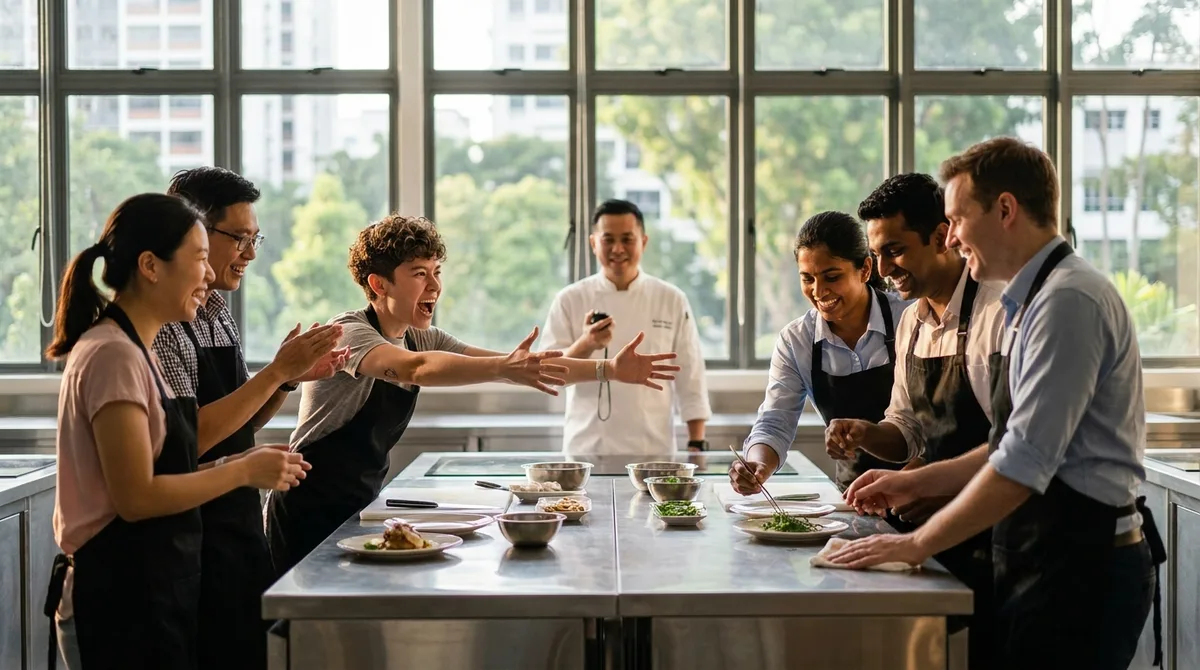
Every team has at least one person who claims they are the best cook in the office. A cooking competition team building Singapore session is the fairest way to settle it, and it happens to be one of the most effective team activities we run. Give people a recipe, a time limit and a rival team at the next station, and something changes. The quiet ones start giving instructions. The managers start taking them.
This guide explains how a team cook-off works, the competition formats that suit different groups, how judging keeps things fair and friendly, and the practical details you need before you book.
Why a cooking challenge beats a standard team activity
Most team building activities ask people to pretend. Trust falls, tower building, escape rooms with imaginary stakes. A cooking challenge asks people to do something real, under real time pressure, with a result you can taste. That authenticity is why people talk about it for weeks afterward.
It also forces the behaviours you actually want to see at work. A team of four cannot finish a dish in the time given unless they agree on a plan, split the tasks and communicate while things are on the heat. Someone has to lead. Someone has to accept that their sauce idea is not going to make the cut. All of this happens without a facilitator lecturing anyone about collaboration.
And unlike a treasure hunt or a sports day, nobody is left out because of fitness, age or confidence. The person who has never held a wok has a job to do, and the dish only works if they do it. That is the difference between an activity people tolerate and one they enjoy.
Cooking competition team building Singapore: how a session runs
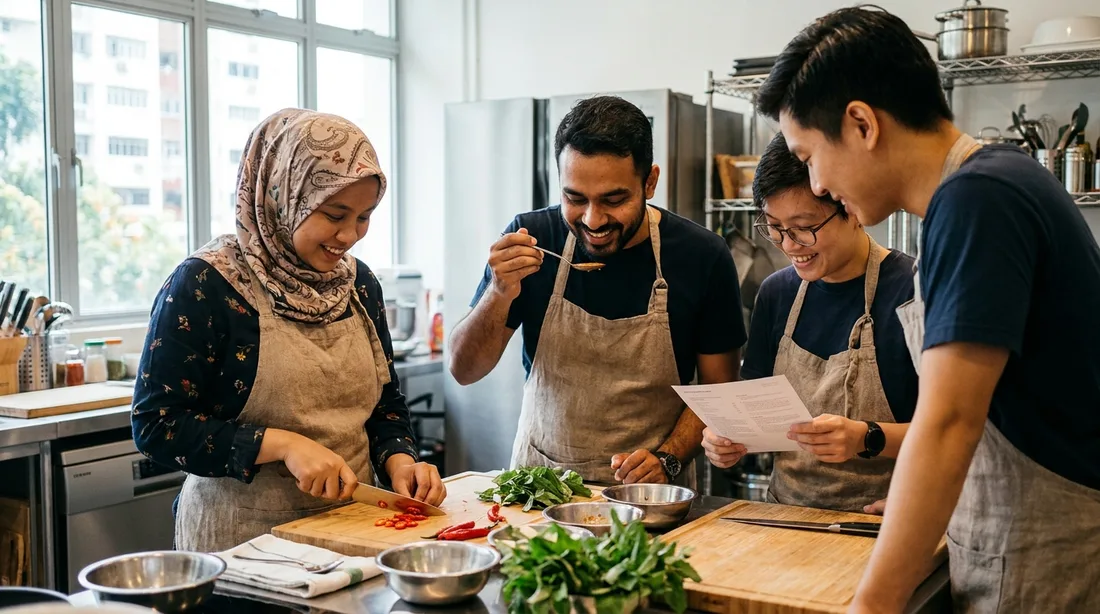
A typical cooking team building competition at our Raffles Place studio follows a simple rhythm. You arrive, the chef briefs everyone, and then the clock starts.
Briefing and demo
The chef walks through the dishes, shows the techniques that matter (how to control heat in a wok, how to fold dumplings so they stay closed, how to plate cleanly) and answers questions. This takes the fear out of the room. By the time teams get to their stations, everyone has seen it done once.
The cooking round
Teams of three to five head to their stations. Each station has the ingredients, equipment and a recipe guide. The chef and assistants move between teams, nudging when something is about to burn and stepping back when a team is in flow. Time checks are called out, which is when the energy in the room picks up.
Plating and judging
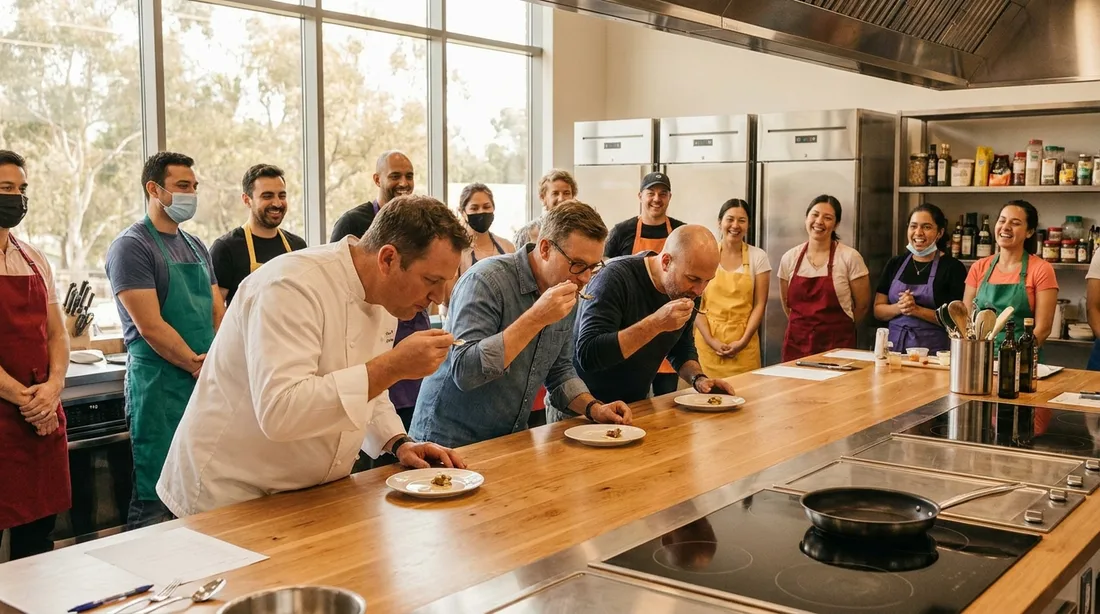
With a few minutes left, teams plate their dishes and bring them to the judging counter. The chef tastes every entry, and we usually invite one or two people from your side to judge alongside. Scores are given, a winning team is announced, and then everyone sits down to eat everything.
Competition formats that work for different teams
Not every team wants the same level of rivalry. A few formats we run, and who each one suits:
- Same dish, best execution. Every team cooks the same recipe and is judged on taste, presentation and teamwork. The fairest format, and the best choice for a first cook-off or a mixed-ability group.
- Mystery box. Teams receive the same set of ingredients with no recipe and must invent a dish. Louder, more creative, and great for teams who already know each other well. Our post on the mystery box challenge goes into how it plays out.
- Multi-course relay. Each team is responsible for one course, and the whole group eats the full meal at the end. Less rivalry, more coordination, which suits large departments and cross-team offsites.
- Masterchef style team building with themed rounds. Two or three short rounds with different challenges, points carried over, and a final tally. Best for sales, project and operations teams who like a scoreboard.
If you are unsure, tell us about the group when you enquire. A team of ten from a startup and a department of fifty from a bank tend to need different formats, and we will suggest one to match.
Keeping it friendly: judging and team mix
A cook-off only works if the competition stays fun. Two things make the difference.
First, judging criteria are shared before the clock starts. Teams know they are being scored on taste, presentation and how well they worked together, not just on who cooked most confidently. That last criterion matters. It rewards the team that got everyone involved over the team that let one strong cook do everything.
Second, team mix. We recommend mixing departments, seniority and cooking ability across teams rather than letting people cluster with their usual lunch group. The point is for the finance lead to take instructions from the intern for twenty minutes. Random draws work well, or you can hand us a list in advance.
Good to know before you book
- Session length: two to three hours, including the briefing, the cooking round, judging and eating together.
- Halal as standard: every dish uses strictly halal-sourced ingredients, so Muslim colleagues take part in exactly the same way as everyone else. If dietary requirements are a concern in your team, our halal team building page covers this in more detail.
- No cooking experience needed: recipes are chosen so beginners can finish them, and the demo covers every technique before the timer starts.
- Central location: the studio is at 18 Robinson Road, #03-02, directly outside Raffles Place MRT (Exit F/G). Easy for a weekday afternoon and simple to reach from most CBD offices.
- Fully managed: we plan the menu, buy the ingredients, run the session and clean up. You bring the people.
- Turn it into dinner: many teams pair the competition with a sit-down meal afterward. See our team building dinner page if you want the cook-off to double as the team dinner.
What teams take away from a cook-off
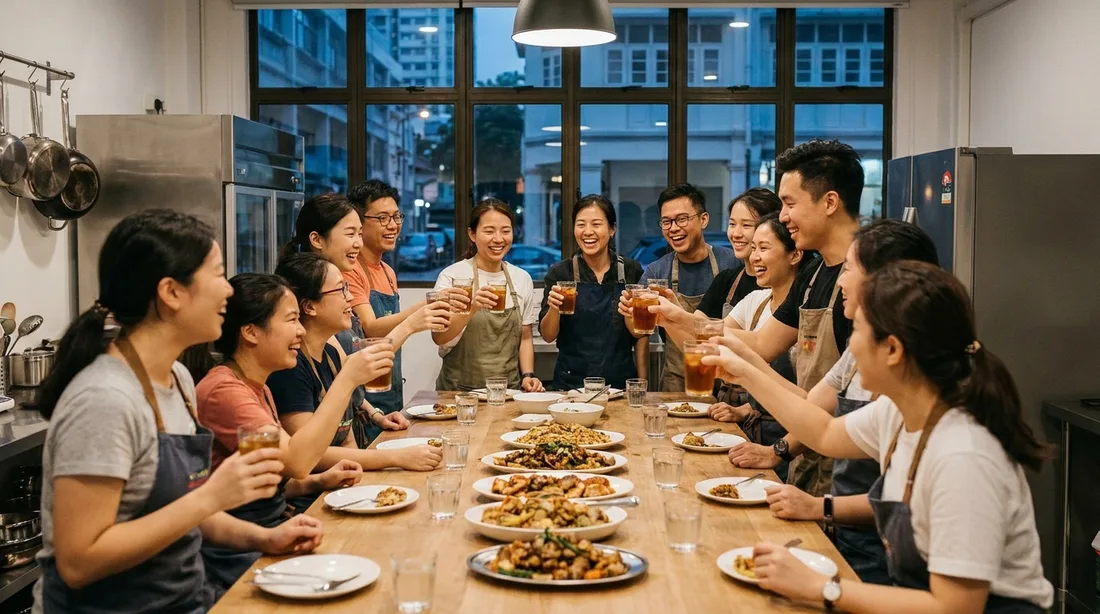
The trophy moment is fun, but it is not the part that lasts. What lasts is the memory of a colleague you barely spoke to talking you through a knife cut, or the whole team laughing at a dish that looked nothing like the demo but tasted great anyway.
Managers often tell us the session gave them a clearer picture of how their team actually works together than a quarter of meetings did. Who steps up when time is short. Who keeps the group calm. Who quietly does the unglamorous prep so everyone else can shine. Those are useful things to know, and a cooking competition surfaces them in an afternoon.
Ready to plan your team cook-off?
If you want a team activity that feels real, includes everyone and ends with a proper meal, a cooking competition is hard to beat. Tell us your headcount, preferred date and the kind of energy your team wants, and we will put together a format and menu to suit. Get a corporate quote or call us on +65 8901 2697 and we will take it from there.
Planning a corporate team-building activity? See our cooking team building experiences in Singapore, or explore corporate team building and team building dinners →
Planning a cooking competition for your team? Tell us your headcount and date and we will handle the rest
Halal-friendly, fully managed, and directly outside Raffles Place MRT (Exit F/G).
Get a corporate quoteFrequently asked questions
What is cooking competition team building?
It is a team building session where colleagues split into small teams and cook against each other under a time limit, with a chef guiding the session and a judging round at the end. The competition adds energy, but the real outcome is a team that has planned, divided work and delivered together.
How long does a team cook-off take?
Most sessions at D'Open Kitchen run two to three hours. That covers the briefing and demo, the cooking round, plating, judging and time to sit down and eat what everyone made.
Do participants need to know how to cook?
No. Recipes are chosen so complete beginners can finish them, and the chef demonstrates the key steps before the clock starts. Mixed skill levels actually make the competition more interesting.
Is a cooking competition suitable for Muslim colleagues?
Yes. Every dish at D'Open Kitchen uses strictly halal-sourced ingredients as standard, so the whole team cooks and eats together without a separate arrangement.
How many people can take part in a cooking challenge?
We host small teams as well as larger departments. Share your headcount when you enquire and we will suggest a team size and format that keeps everyone busy rather than watching from the side.